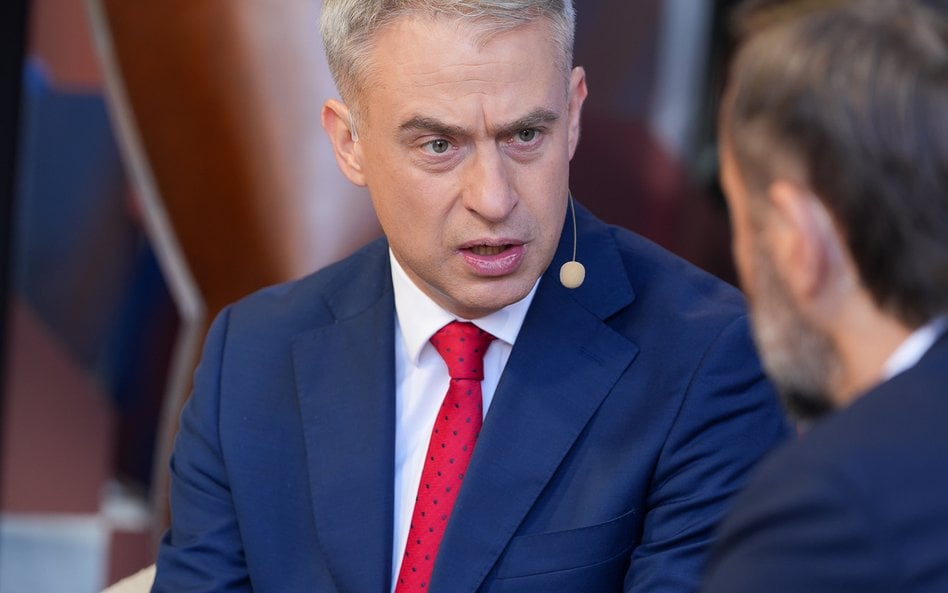
Krzysztof Gawkowski, Deputy Prime Minister and Minister of Digital Affairs, was a guest at the Rzeczpospolita Lounge during the Economic Forum in Karpacz. Cezary Szymanek, deputy editor-in-chief of Rzeczpospolita and editor-in-chief of Parkiet, questioned him on topics including his participation in the G20 summit and the growing importance of digitalisation and cybersecurity. ‘Digitalisation is one of the key global issues today, with artificial intelligence right at the centre of interest. This topic featured prominently at the G20,’ Gawkowski noted, adding that Poland was spoken of highly in this context. The Deputy Prime Minister highlighted the growth of the Polish economy, which—as he put it—has reached a value of one trillion dollars. In his view, digitalisation has played a vital role in this success, pointing to the development of digital services, robust cybersecurity, effectiveness in fending off cyberattacks, and popular apps like mObywatel and BLIK. ‘We are a nation that has invested in ensuring citizens recognize digitalisation as part of daily life, and today they are reaping the benefits,’ he emphasised.
Data leak aftermath
The discussion also touched upon the recent data leak at MyDr. Cezary Szymanek noted that, for the 19 million citizens affected, an incident like this has the potential to define how they perceive cybersecurity. Gawkowski assured that the state responds swiftly and decisively in such cases: on the one hand requiring the company to take immediate data protection measures, and on the other providing government support. The firm must also prepare for inspections and potential fines determined by the Personal Data Protection Office. ‘Our aim was to secure this data so that criminals could not sell it on the black market. We informed citizens how to check whether their data had been leaked and how to protect it,’ said the Deputy Prime Minister. He pointed out that although the breach occurred at a private company, the state reacted without delay. He also encouraged citizens to block their PESEL identity numbers, reporting that 3 million people did so within the first three days following the leak. Gawkowski addressed proposals for automatically blocking all PESEL numbers, arguing that such a measure could disrupt daily life for some citizens, particularly elderly people who are less familiar with new technologies. ‘We must educate people and encourage them to learn. That is why the state is investing a record one billion zlotys in digital skills today,’ he said. He added that training programmes cover senior citizens, children, civil servants, teachers, and businesses, aiming to raise awareness of threats and protective measures. ‘Citizens are the first line of defence and must protect themselves,’ he emphasised, warning that as Poland is currently the most frequently targeted country in the European Union, further cybersecurity incidents are to be expected.
Businesses must invest in security
Following the MyDr data leak, the Ministry of Digital Affairs prepared a legislative package designed to reduce the risk of similar incidents in future. Gawkowski expects these measures to come into force as soon as possible, potentially as early as the start of next year. However, he acknowledged that the proposed solutions are meeting resistance from certain businesses. ‘I am in favour of putting pressure on companies and telling them clearly: you must invest in cybersecurity,’ he stated.
One proposal stipulates that private companies processing more than 100,000 records containing PESEL numbers must implement enhanced security measures, including appropriate systems, regular audits, and a secure IT environment. ‘Many companies argue, “Yes, but that requires investment.” Our response is: If you profit from data, you must invest in its security. The state enables you to do business, but it also demands this duty of care,’ explained the Minister of Digital Affairs. The Deputy Prime Minister also highlighted regulations concerning the national cybersecurity system. Businesses will have to determine whether they fall within the scope of the new obligations. The Ministry is preparing detailed guidelines on the matter, with Gawkowski emphasising that the scale of these changes is substantial.
The scope of the national cybersecurity system, which just six months ago covered around a thousand companies, is set to expand to 40,000 entities. According to the minister, the reluctance of certain businesses towards cybersecurity spending remains a challenge. To date, such expenditure has frequently languished at the bottom of priority lists—behind investments in business development, communications, or marketing. ‘We must elevate cybersecurity on the agenda of executive boards, CEOs, and business owners,’ Gawkowski argued. He pointed out that data security directly impacts corporate reputation, noting that a successful cyberattack brings not only technical disruption, but also a loss of client trust and subsequent financial damage. ‘Investing in security is ultimately an investment in company growth,’ he concluded.
Fines for Meta
The Minister of Digital Affairs also addressed Meta’s practices regarding fraudulent advertisements. He assured that he has no intention of backing down from his demand for penalties against the tech giant. While the European Commission has yet to respond to the formal request, Gawkowski pointed out that Meta has already acknowledged its shortcomings. According to the minister, the company announced plans to increase its monitoring of scam ads from 70 per cent to 90 per cent—a threshold he deems inadequate. ‘Every Polish victim tricked by fraudulent ads loses hard-earned money, which is why monitoring must be as close to 100 per cent as possible,’ he stated.
The Deputy Prime Minister argued that, given the financial losses suffered by many people due to these scams, financial penalties are fully justified. He proposed a fine of EUR 250 million (approximately PLN 1 billion), noting that such an amount represents a negligible burden relative to the tech giant’s vast turnover. ‘Let them pay the fine, and let that money go to the victims who lost out. That is only fair,’ he stated.
Gawkowski also assured that the demand to penalise Meta enjoys support from other nations. During the G20 summit, he discussed the matter with the EU representative responsible for digital policy. Looking ahead, he did not rule out assembling a coalition of European states to jointly demand compensation from major tech corporations for such abuses.