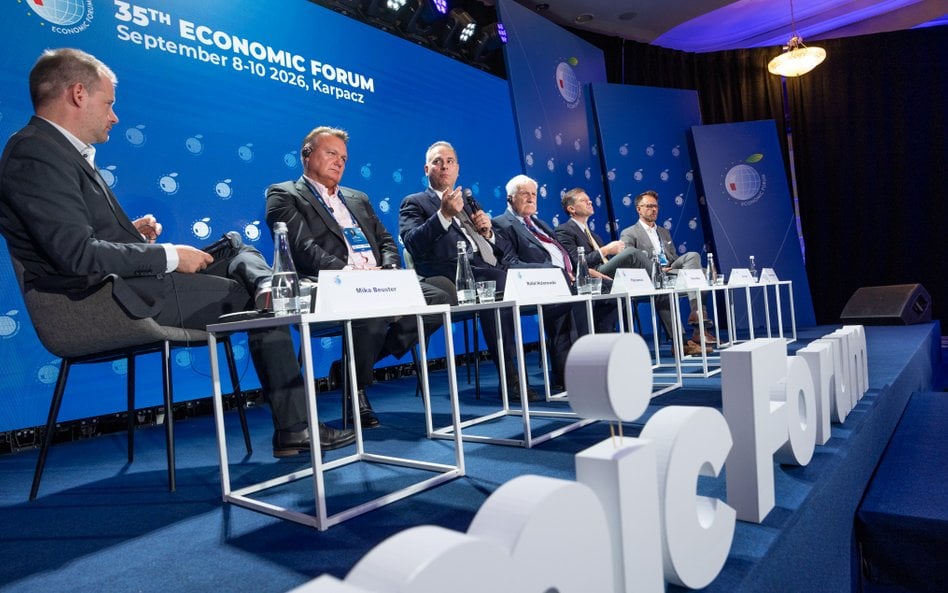
'I’ve always thought that there is too much talk about leadership. It is not a real problem. What is needed is an efficient political and economic system, because that is what can create leaders', said Václav Klaus, President of the Czech Republic between 2003 and 2013. He does not consider himself a 'leader of tomorrow'. 'I was one 35 years ago, at the time of the fall of communism. We wanted to get rid of all its remnants and build a truly free society. And as a "leader of tomorrow" of that kind, I must say that I am frustrated by the current situation. We haven’t made much progress', he observed bitterly.
Another panel participant actively involved in politics is Filip Ivanović, Montenegro’s Deputy Prime Minister for Foreign and European Affairs, who studied philosophy. He pointed to philosophy as the subject future leaders should study. 'When you study many different theories, including those very far removed from what is close to your heart, you become better at understanding other people’s viewpoints and organising them into a logical framework. This then helps you to formulate your own arguments more effectively', he said.
Many mediocre leaders
Ivanović pointed out that education should no longer focus on acquiring information, as this is now 'just a click away'. He emphasised the importance of credibility, integrity and above all empathy, which – in his view – continues to disappear.
Hal Brands, an American expert on geopolitics and historian from Johns Hopkins University, provided broader context for the discussion about leadership. In his view, the era of dominance by the US and its allies, market expansion and globalisation is coming to an end. 'The question is not whether fragmentation will be greater in ten years’ time, but along what lines it will run and how far it will go', he said.
Brands disagreed with the claim that this is the result of ineffective leadership. 'I am a historian and I know that the quality of leadership varies from one era to the next. There are always outstanding leaders, weak leaders and plenty of mediocre ones', he said. In his view, it is primarily the conditions in which leaders must operate today that are difficult. Hence the advice for future leaders from the former Special Assistant to the Secretary of Defence for Strategic Planning: study history. 'This is the only place to see what forms of leadership have worked in the past and what forms have not. It is the only laboratory in which one can test how leadership works in real life', he stated.
What AI cannot do
Brands also warned against the role that artificial intelligence plays in education and the development of leaders. He noted that the ability of AI to write a B+ essay in a matter of seconds poses a threat to students’ ability to think for themselves.
All panellists denied that the role of leaders would soon be replaced by artificial intelligence and that managerial positions would no longer be needed.
'AI is a support tool, but it cannot replace leaders. Leaders, on the other hand, must make sure that their teams know how to use this new technology', said Włodzimierz Wlaźlak, CEO of Lidl Polska.
'Artificial intelligence can only support the decision-making process, but it does not change the fact that, as a leader, I am responsible for the decisions made', agreed Rafał Holanowski, President of the Management Board of Supra Brokers.
Risk the Polish way
As an example of an unconventional approach to business, Włodzimierz Wlaźlak cited the introduction of self-service checkouts in all Lidl Polska stores. The Polish subsidiary was the first in the entire group to implement this solution. 'Theoretically, it should be the other way round, because labour costs in Western Europe are higher than here. But we were the first to do it and we proved that it makes sense', he emphasised.
In his view the cultural factor is significant here, because Germans – and, more broadly, people in Western Europe – are more risk-averse than Poles. 'Over there everything has to be discussed, debated, and then analysed yet again. We feel we don’t have that time. We make decisions and move forward, often intuitively, and we treat mistakes as something we can learn from', he said.
The CEO of Lidl Polska did not, however, agree with the view that good leaders are hard to come by these days. He believes it is crucial to give employees the space to work independently and to make mistakes. 'I have brilliant teams in every department. The only question is whether the boss allows people to do their job and whether there is room to make mistakes. That’s how people improve. You have to trust people', he concluded.