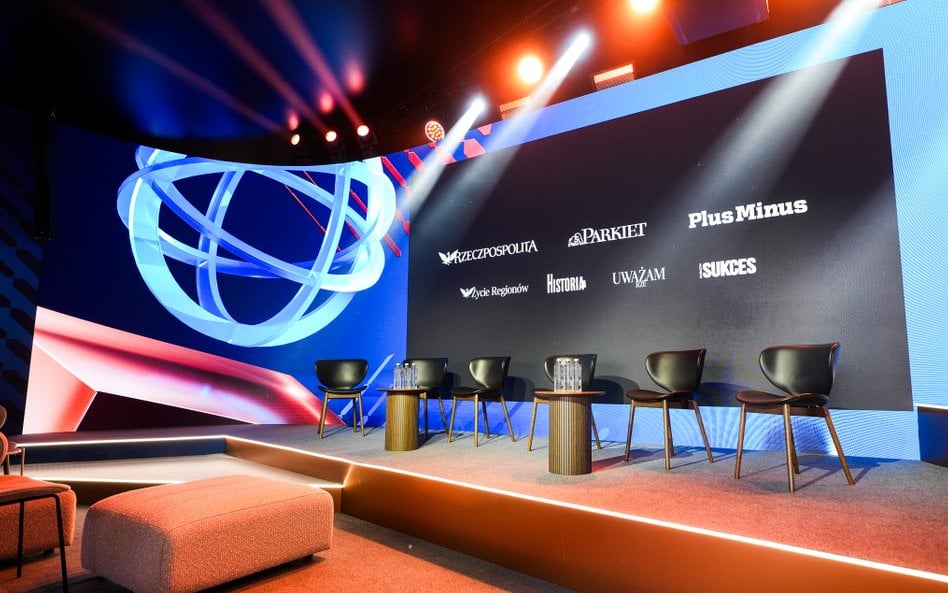
For three days Karpacz is going to be the place for discussions on things that have the greatest impact on the future of the Polish economy today and will determine its competitiveness. The programme of the Economic Forum includes sessions and panels with government officials, business people, local government representatives, academics and experts.
An important part of these discussions are debates organised by the Rzeczpospolita newspaper. The editorial team is going to address, for example, the consequences of the demographic crisis, the future of science funding and consumer protection in a changing credit market.
Science as a strategic investment of the state
Tuesday, 8 September, 2.30pm–3.30 pm, Rzeczpospolita Lounge
How much should Poland invest in science if it wishes to build an innovative economy? And what kind of higher education system do we want to create? Rectors from leading universities and a representative from the Ministry of Science and Higher Education will discuss the future of higher education funding.
According to data from Statistics Poland, expenditure on research and development in Poland in 2024 amounted to PLN 51.5 billion, which was 3.1 per cent lower than the previous year. This represented 1.41 per cent of GDP, while the European Union average stood at 2.24 per cent. Poland ranked 15th in the EU in this respect. The gap is even more striking when calculated per capita: R&D expenditure in Poland stood at EUR 326, compared with an EU average of EUR 897.
The business sector remains the largest contributor to research and development. In 2024 companies accounted for 63.3 per cent of national R&D expenditure, and the higher education sector for 34.4 per cent. This shows that the debate on science funding concerns not only university budgets, but also Poland’s capacity to generate innovation and translate research findings into economic development.
It is in this context that participants in the debate ‘Science as a strategic state investment. What financial arrangement for Polish universities?’ will discuss expenditure on science, the role of stable institutional grants and the rules governing their allocation.
Investment in people and research infrastructure will be a key topic. Experts are also set to consider the role of endowment funds and private funding as additional sources of university funding, as well as methods for reconciling academic autonomy with accountability for the use of public funds.
Debate participants: Prof. Maria Mrówczyńska, Under-Secretary of State at the Ministry of Science and Higher Education; Prof. Alojzy Nowak, Rector of the University of Warsaw; Prof. Piotr Jedynak, Rector of the Jagiellonian University; Prof. Marek Pawełczyk, Rector of the Silesian University of Technology; and Prof. Arkadiusz Wójs, Rector of the Wrocław University of Technology.
The future of consumer protection in the credit market
Tuesday, 8 September, 3.45pm–4.45 pm, Rzeczpospolita Zone
Do regulations, credit information exchange systems and anti-fraud technologies really protect consumers effectively today? And do regulations keep pace with the rapidly changing financial market? These are the main questions of the debate ‘The future of consumer protection in the credit market: regulations, technologies, standards’, scheduled to take place in the Rzeczpospolita zone.
The discussion will focus on the three pillars of a secure market: modern regulations, technological innovation and responsible market standards. Experts will assess, for example, the extent to which a reliable creditworthiness assessment and an institutionalised system for the exchange of information can protect the budgets of Poles from a debt spiral.
The discussion will also cover new forms of financing, such as BNPL and fast instalments, as well as the implementation of the EU’s CCD2 Directive. The role of cybersecurity and advanced analytics in combating financial fraud will be explored as a separate topic.
Debate participants: Prof. Andrzej Rzońca from the SGH Warsaw School of Economics, Sławomir Grzelczak, Vice-President of the Management Board of the Credit Information Bureau, and Agnieszka Wachnicka, Vice-President of the Polish Banks Association.
Digital mainstream. New sales models
Tuesday, 8 September, 5.00pm–6.00 pm, Rzeczpospolita Zone
Social media has become more than just a place for communication and entertainment; it is also a space where purchasing decisions are made. For Polish companies, particularly small and medium-sized enterprises, this creates an opportunity to reach customers without the need to build costly sales infrastructure.
Whether the new retail model can stimulate growth for Polish companies is the subject of a debate ‘The digital mainstream: How new ways of discovering brands boost the Polish economy’, scheduled to take place during the Economic Forum in Karpacz in the Rzeczpospolita Lounge.
The scale of the digital change has become increasingly evident in the data as well. According to Eurostat, in 2025, 63.6 per cent of companies in the European Union that employ at least 10 people used social media as users. In Poland the figure stood at around 50 per cent. So the gap remains significant. An even greater difference is evident in the use of paid online advertising. In 2024 23.2 per cent of Polish companies used it, compared to an EU average of 32.6 per cent.
At the same time, commerce and social media continue to become increasingly intertwined. The customer’s journey from initial contact with a product to the purchase decision is no longer linear. A consumer may discover a brand through a creator’s video, an algorithm’s recommendation or content appearing in their feed, and then proceed directly to a purchase. This phenomenon, known as ‘discovery commerce’, changes the traditional division between social media, advertising and e-commerce.
For small and medium-sized enterprises, this may mean a lower barrier to market entry. A local manufacturer does not need to have the marketing budget of a global brand to reach a large audience. Their success may depend on the appeal of their product, their ability to utilise the platform, partnership with content creators, and their ability to capture the algorithm’s attention. The question, however, is whether this truly democratises market access, or whether it merely shifts the entrepreneur’s dependence from traditional intermediaries to the largest technology platforms.
This dilemma will be one of the topics of discussion in Karpacz.
Discussion participants: Agnieszka Durlik, Director General of the Court of Arbitration at the Polish Chamber of Commerce and a member of the Chamber’s Management Board; Łukasz Gabler, Head of Public Policy and Government Affairs at TikTok CEE; Kamil Rybikowski, Chief Specialist at the Polish Craft Association; and Patrycja Sass-Staniszewska, President of the Management Board of the Chamber of Digital Economy.
Rzeczpospolita recommends
- Leader 2030: new leadership in business, part I | Tuesday, 3.30 pm, University of Warsaw zone
- Sports sponsorship: passion or business? Who plays, who pays and who wins? | Tuesday, 6.05 pm, room: 6.12
- How did the distinction between ‘generic’ and ‘innovative’ medicines come about? Domestic Drug Manufacturers | Tuesday, 7.15 pm, room: 6.25