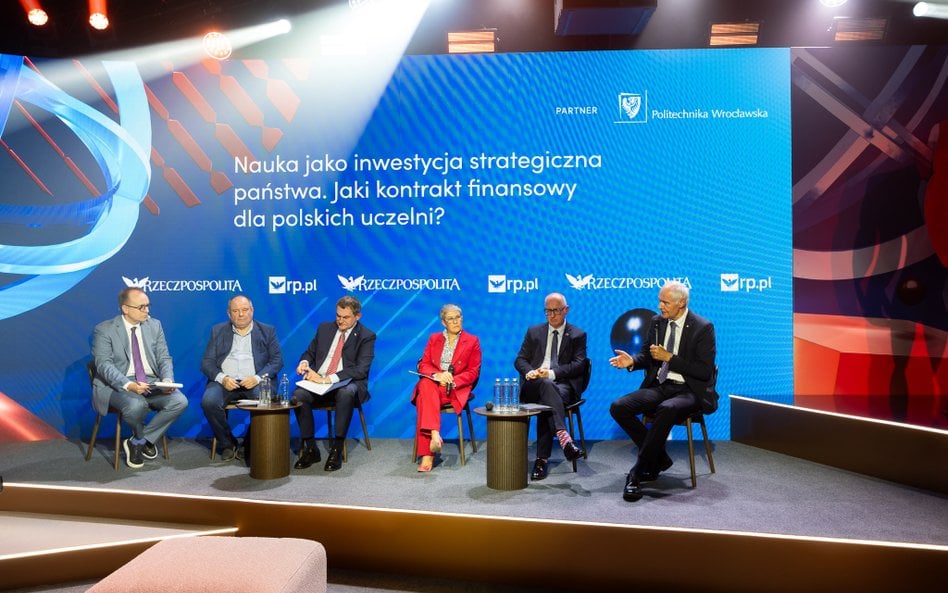
The panel hosted in the Rzeczpospolita lounge was entitled ‘Science as a strategic state investment. What financial arrangement for Polish universities?’. In the draft state budget for 2027, the spending limit for the Ministry of Science alone stands at over PLN 38.4 billion, nearly PLN 2.7 billion higher than the previous year. When the research and development expenditure of other ministries and funds is included, total funding for the sector exceeds PLN 47 billion —still roughly 1 per cent of GDP.
‘The right question, from the perspective of a country that ranks among the world’s twenty largest economies, should be: how much does the lack of good science cost us?’ said prof. Piotr Jedynak, Vice-Chancellor of the Jagiellonian University, questioning the very premise of the discussion. ‘In the area of defence, we incur enormous costs to compensate for the fact that we do not make use of research findings in Poland,’ he added.
Most of the money goes to students
Prof. Maria Mrówczyńska, Undersecretary of State at the Ministry of Science and Higher Education, pointed out that the very term ‘science funding’ is misleading. ‘This term primarily refers to the funding of student education at public universities. We allocate the lion’s share of the budget to this very purpose, and an incomparably smaller amount to research carried out by institutes of the Polish Academy of Sciences, independent research institutes, or the Łukasiewicz Research Network,’ she explained.
Prof. Marek Pawełczyk, Vice-Chancellor of the Silesian University of Technology, drew attention to the algorithm for allocating funds to public universities and scientific institutes—one of the most complex mechanisms in Polish public administration. ‘From these funds [subsidies – ed.], we have to pay for what is measurable and what we are assessed on, but this is also money that we invest in young people, in attracting talent, and in new areas of research. There is no algorithm for this, so we have to develop our own internal one,’ he explained.
Prof. Arkadiusz Wójs, Vice-Chancellor of Wrocław University of Science and Technology, pointed out that quality is poorly reflected in this mechanism. ‘Research categories account for only a quarter of the subsidy. Even if a university like ours were to have all its categories lowered by one level, that quarter would only change by roughly a quarter,’ he calculated. In his view, the increase in funding in recent years has merely offset the effects of cumulative inflation.
A ‘starved’ grant system
According to prof. Arkadiusz Wójs, ‘a bigger problem than an insufficient subsidy is a starved grant system.’ The success rate in competitions organised by the National Science Centre (NCN) has fallen to around one in six, whereas a level of 20 to 25 per cent is considered ‘healthy’ and safe for the proper development of science in Europe.
‘This means that good projects are being rejected, and researchers are wasting a great deal of time preparing or evaluating applications rather than conducting research,’ he said. His solution is to increase the NCN’s budget from PLN 1.7 billion to around PLN 3 billion (the draft state budget for 2027 currently allocates PLN 2.15 billion to the NCN).
The Vice-Chancellor of Wrocław University of Science and Technology also rejected the argument that European grants could fill the gap. ‘ERC [European Research Council – ed.] grants are only for the absolute European elite, whilst the NCN’s role is to create that elite in the first place,’ noted prof. Wójs.
In any case, the effectiveness of Polish research teams at the European level is a separate issue entirely. ‘In the latest round of ERC Starting Grants, only six people from Poland received funding,’ said prof. Piotr Jedynak.
Deputy Minister Maria Mrówczyńska admitted that this has implications for discussions with the Ministry of Finance. ‘The Minister asks me: why should I pay so much into Horizon [the EU’s framework programme for research and innovation – ed.] if you are unable to recoup it?’ she relayed.
How much is the University of Warsaw worth?
Prof. Alojzy Nowak, Vice-Chancellor of the University of Warsaw (UW), presented a broader vision. He began with a comparison: Stanford University has around 18,000 students, a budget of some USD 9 billion, and endowment funds amounting to USD 40 billion. ‘That’s the entire budget of the Ministry of Science and Higher Education, just to give you a comparison,’ added prof. Mrówczyńska. ‘Vice-Chancellors aren’t interested in the ministry’s budget, only that of their own universities,’ replied prof. Nowak.
The University of Warsaw educates around 43,000 students, employs roughly 10,000 staff, and operates on a budget of PLN 2.5 billion, of which PLN 1.5 billion comes from government subsidies and around PLN 750 million from grants. ‘In the foreseeable future, there will not be enough money to fund Polish universities at the level of the top fifty American universities. We cannot wait; we must take matters into our own hands,’ urged prof. Nowak.
The Vice-Chancellor of the University of Warsaw put forward the idea of introducing endowment funds at Polish universities, invested in safe instruments, primarily bonds. For his university, this would amount to approximately PLN 10 billion. ‘We do not expect cash from the budget. These could be bonds,’ he pointed out. The second pillar would be alumni contributions. ‘There’s no point expecting anyone to chip in PLN 50 or PLN 100 million. However, if they each contribute PLN 2,000 or PLN 3,000, and considering there are plenty of them, there’s a genuine chance of raising around a billion,’ he said. The third element would be the issuance of bonds by the universities themselves, though this would require legislative changes.
A prerequisite, as the UW Vice-Chancellor pointed out, is a realistic valuation of university assets. Officially, the University of Warsaw’s assets are valued at PLN 5.5 to PLN 6 billion; however, according to prof. Nowak, the historic campus on Krakowskie Przedmieście alone is worth PLN 20 to PLN 25 billion. Taking into account the second campus in the Ochota district and nearly 200 other buildings, the vice-chancellor estimated the university’s true value at PLN 65 to PLN 75 billion. ‘It is one thing to issue bonds worth a billion or two when you have a collateral base of 70 billion, and quite another when that base is 5 billion. The factor of fear and risk aversion simply disappears,’ he explained. ‘Without resolving these issues, it is difficult to talk about serious investment in science,’ he argued.
Risk aversion
Prof. Piotr Jedynak accepted the proposal with some reservations. ‘As a private individual, you may well live to see a solid capital base financed in part by public funds. As vice-chancellor, perhaps not,’ he told prof. Nowak. ‘Risk aversion is also a characteristic of every finance minister,’ he noted. He emphasised, however, that even doubling subsidies would have no effect if a university's potential ‘is unable to utilise these funds.’
Prof. Arkadiusz Wójs, Vice-Chancellor of Wrocław University of Science and Technology, calculated that if each of his university’s more than 200,000 graduates were to contribute PLN 1,000 to an endowment fund, the total would amount to just PLN 200 million. ‘And a fixed capital of one billion, from which 5 per cent can be withdrawn each year, yields PLN 50 million. That is simply not enough. This money must come from the broader economy and the state budget,’ he added.
‘Core funding should be available to all, but strategic funding requires a focused approach, because we will not live to see a time when Poland has unlimited resources,’ said prof. Jedynak. In turn, according to prof. Wójs, endowment funds should be established primarily at larger universities that actively support the state in developing vital technologies.
Prof. Marek Pawełczyk, Vice-Chancellor of the Silesian University of Technology, highlighted an area covered by neither subsidies nor grants. ‘There is a lack of funding for truly groundbreaking research—the kind capable of making Poland a global leader in a particular field, perhaps in ten years’ time, or even later,’ he said. He cited Nobel laureate Victor Ambros, who spent two decades conducting research into microRNA [short, non-coding RNA molecules that regulate gene activity, influencing, amongst other things, the amount of protein produced by cells; they play a vital role in many biological processes and the development of diseases – ed.] without any spectacular early results, yet today this fundamental research has led to the concept of cancer vaccines. ‘If someone hadn’t provided funding for such a long period, this would never have happened,’ remarked prof. Pawełczyk.
‘If immediate results are expected from research funding, then it is no longer science. Investments are made “just in case”,’ added prof. Alojzy Nowak. In his view, the second missing piece of the puzzle is commercialisation. ‘There is no mechanism to fund the introduction of research achievements to the market. It is not just about patenting [...]. There is no institution willing to take the risk, fully aware that, out of a hundred projects, perhaps only two or three will succeed,’ said the UW Vice-Chancellor.
Predictability in exchange for accountability
When asked about the ideal form of a contract between the state and universities, prof. Piotr Jedynak, Vice-Chancellor of the Jagiellonian University, gave a straightforward answer. ‘Instead of annual uncertainty as to whether one model or another will be adopted, we need stability spanning several years, as this will make the system predictable,’ he stated. ‘The subsidy actually goes towards teaching. Research funding should be a completely separate stream, based on competitive procedures rather than on the standard subsidy allocation algorithm,’ he added.
‘University autonomy is enshrined in the constitution. It becomes a fiction if funding is meagre and, moreover, highly uncertain from one year to the next,’ concluded prof. Wójs. ‘In return for this predictability, universities should commit to their responsibilities within a social contract: proving that we are capable of spending this money not equally, but by prioritising excellence and public benefit,’ he said.
‘We have over a hundred universities that are crucial to their respective regions,’ added prof. Maria Mrówczyńska. ‘I agree that there are some which are clear leaders, but we must also pay attention to those which do not feature so highly in the rankings,’ she said. The Deputy Minister for Science also expressed her hope that external funding would become the second pillar of university financing, with the core government grant serving to cover day-to-day needs and staff salaries.