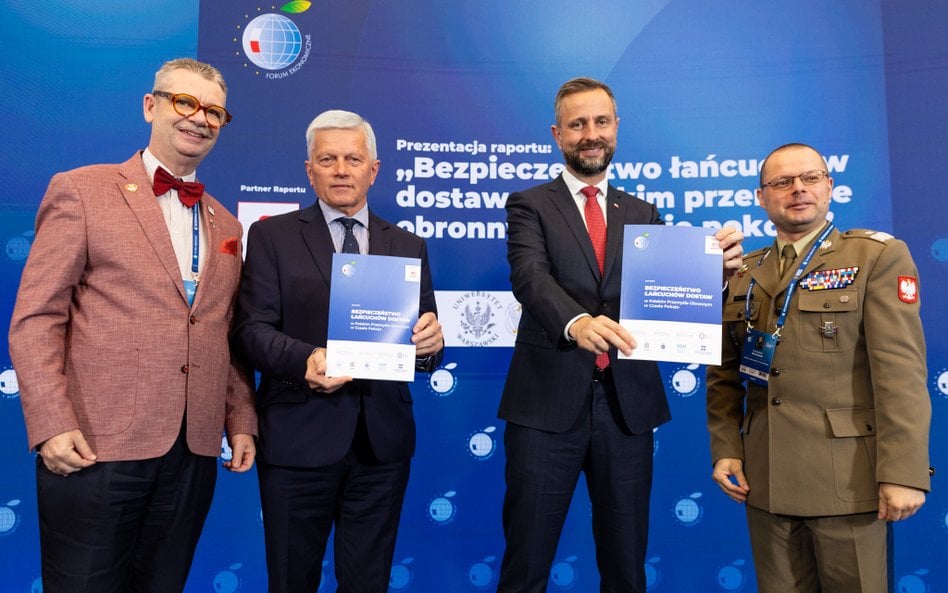
The report was presented to Deputy Prime Minister and Minister of National Defence Władysław Kosiniak-Kamysz during the 35th Economic Forum in Karpacz. Two years in the making, the document was prepared by researchers from the Warsaw School of Economics, the Military University of Technology, the AGH University of Krakow, the University of Warsaw, the Kraków University of Technology, and the Jagiellonian University, with the support of the Ministry of National Defence, the Ministry of State Assets, the Ministry of Development and Technology, and Orlen. Work was coordinated by the Institute of Eastern Studies.
According to dr Krzysztof Michał Księżopolski of the Warsaw School of Economics, the research and development head of the project, a paradigm shift is needed. ‘It is not about how much equipment we buy, but what defence capability we are building and whether we will be able to maintain it in the event of a crisis or war,’ he said. In his view, every strategic contract should cover the entire lifecycle of a capability — from procurement and production, through operation and maintenance, to modernisation, replenishment, and overhaul. ‘Final production or assembly in Poland alone does not yet constitute technological sovereignty. Every strategic defence expenditure must also be evaluated in terms of the lasting domestic capabilities we build as a result,’ he emphasised.
Dependency map
Dr hab. Marzenna Cichosz from the Warsaw School of Economics (SGH) argued that Poland does not need to be entirely self-sufficient. ‘We must, however, know on whom and on what we depend,’ she pointed out. The report’s authors therefore recommend a security map covering critical suppliers, raw materials, components, technologies, and vital infrastructure. The map is also intended to show how quickly production capacity can be scaled up and restored following a potential crisis. ‘It is risk management, not self-sufficiency, that builds a country’s resilience and security,’ said Cichosz.
Consultations with industry players, including Polska Grupa Zbrojeniowa and WB Group, indicate that the sector expects faster regulatory reform, streamlined certification, accelerated funding allocation, and operational feedback from the armed forces on equipment performance. According to the authors, the Ministry of National Defence and Agencja Uzbrojenia (Armaments Agency) should act as overarching integrators of defence capabilities, transcending individual contracts and institutional silos.
Księżopolski also drew attention to human resources. ‘Losing just a few key experts could mean losing critical expertise,’ he warned. The authors advocate succession programmes and the establishment of a dedicated managerial corps to ensure a stable leadership team for strategic enterprises and projects. ‘We also wanted to dispel the myth that a state monopoly equates to security. That is simply not the case,’ he added.
Among the proposed principles for procuring defence capabilities, he listed supply chain security as a key product evaluation criterion, alongside market competition and flexibility.
The price of blood
Deputy Prime Minister Kosiniak-Kamysz announced that the report’s recommendations would be analysed and implemented across government, not solely within his own ministry. ‘There is no such thing as cheap security. It is cheaper to relocate a factory to India, whereas manufacturing in Europe can be significantly more expensive. But the greatest cost is losing the supply chain from India or China when war breaks out. Then the price we pay will no longer be measured in any currency — often, it may be paid in blood,’ he said. As an example, he cited shortages of missiles for Patriot systems due to centralised production, adding that the Ministry of National Defence is seeking to transfer part of this manufacturing to Poland.
According to dr Andrzej Grzyb, Chairman of the Sejm’s National Defence Committee, these dependencies extend far beyond the supply of arms and ammunition. ‘A state’s strength is measured by the combined capabilities of its economy. If the majority of active pharmaceutical ingredients are produced in India and China, what sovereignty do we actually have in manufacturing the medicines needed in times of crisis and conflict?’ he asked. The subcommittee on defence industry modernisation, which he chairs, was presented with the first draft of the report in June, and the National Defence Committee is now set to consider the document in its final form.