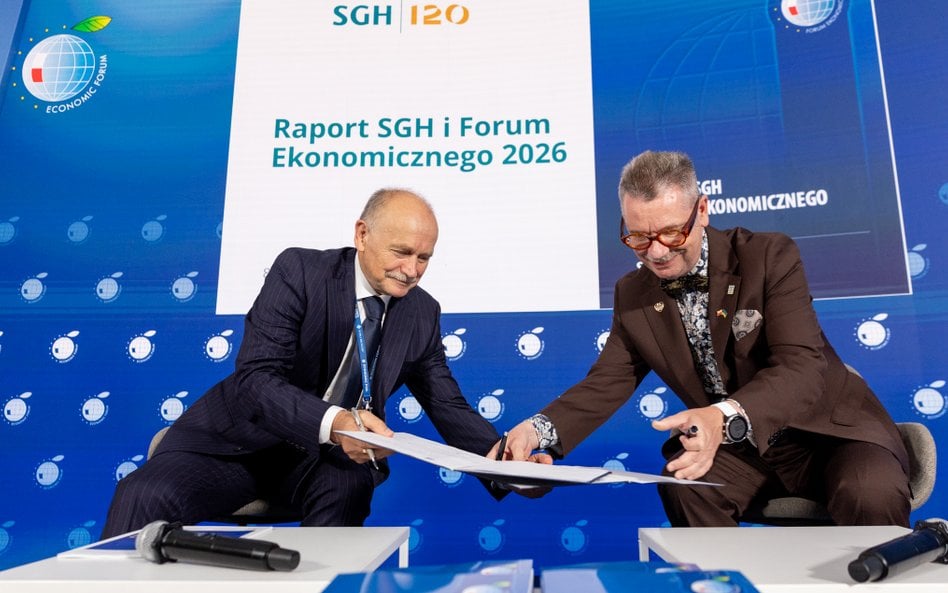
The unveiling of the annual report by the Warsaw School of Economics and the Economic Forum marked the launch of the 35th Economic Forum in Karpacz on Tuesday. More than 50 researchers from SGH and other institutions contributed to this year’s publication, delivering a comprehensive analysis of the crucial challenges and trends shaping the development of Poland and the wider Central and Eastern European region.
‘The publication combines economic, technological, social, and geopolitical perspectives, demonstrating how to build economic resilience and competitiveness in the face of dynamic change,’ the authors note. They add that the report goes beyond identifying key problems by outlining development scenarios and offering recommendations for public administration, business leaders, and the institutions responsible for shaping economic policy.
This year’s joint SGH and Economic Forum report features ten expert studies addressing pivotal challenges for Central and Eastern Europe, including Poland. These cover a broad spectrum of issues, ranging from investment, energy, and the labour market to innovation, health, and food security.
Two decades of catching up with wealthier nations
The authors note that while the Central and Eastern European (CEE) region is a growth leader within Europe, it lags behind on a global scale. Between 2005 and 2025, CEE nations grew by an average of 3 per cent per annum. This outpaced the US, which recorded 2.1 per cent growth, as well as countries representing all four models of Western European capitalism, which saw rates between 0.7 and 1.6 per cent. However, the economies of South-East Asia (4.9 per cent) and the BRICS nations—the emerging markets of Brazil, Russia, India, and China (6.8 per cent)—expanded at a more rapid pace.
According to the report, per capita income in CEE countries, measured by purchasing power parity, rose from 37 per cent of the US benchmark in 2004 to 58.4 per cent in 2025. ‘A key factor driving this process was the membership of the group of countries under analysis in the EU,’ the authors write. This accession ‘contributed to improving the quality of institutions, opened up the single market, and boosted exports and the inflow of foreign investment, whilst access to EU funds enabled the financing of infrastructure modernisation and the education of the population.’ At the same time, this progress highlighted a stark contrast with Western Europe, which drifted further behind the US during the same period. Per capita income in the EU-15 fell from 81 per cent to just under 76 per cent of the US level, while Southern European nations saw an even steeper decline, the experts add.
The report's authors assess that the most significant barrier to rapid economic growth is the institutional short-sightedness of the ‘patchwork’ model of capitalism. This economic framework, which has taken shape across our region, combines mismatched and often contradictory elements drawn from various Western capitalist models alongside post-communist legacies. ‘Weak institutions, state failure, unfavourable demographics, and a low propensity for innovation reduce the chances of maintaining a rapid pace of real convergence in the future,’ they conclude.
In their view, sustaining the current pace of development requires a transition from quantity-driven growth to an economy fuelled by innovation and higher productivity. The authors advise taking targeted action in two interrelated areas. Firstly, they recommend institutional reform: enhancing institutional coherence, legal stability, and the enforcement of the rule of law, alongside curbing state capture and strengthening bodies that generate and disseminate knowledge. Secondly, they call for a new development strategy to shift production and exports towards higher value-added sectors. This approach must include increased spending on research and development, improvements in the quality of human capital, and the stabilisation of public finances.
In a dedicated section of the report, the experts evaluated the region's economic performance over the past year. They noted that, despite the pressures of deglobalisation, the war in Ukraine, high deficits, and rising public debt, the economic situation in the region had actually improved compared with 2024. CEE economies outpaced the EU-15, expanding by an average of around 2.35 per cent annually, in contrast to the 1.5 per cent growth seen across the EU as a whole.
Poland emerged as the region’s growth leader. Driven by robust domestic demand and investment, our real GDP increased by 3.6 per cent. Furthermore, Poland was the only nation to expand its share of the overall EU economy, whilst simultaneously boasting the second-lowest unemployment rate in the region.
Three paths for the region's countries
CEE nations broadly followed three distinct trajectories. Bulgaria, Croatia, and Poland were characterised by high, consumption-driven growth. Conversely, sluggish growth—stemming not only from the broader economic cycle but also from weakened competitiveness and strained public finances—was recorded in Romania, Serbia, and Slovakia. Meanwhile, the Czech Republic, Slovenia, Hungary, and the Baltic states experienced moderate economic expansion.
According to the joint report by SGH and the Economic Forum, our corner of Europe remains particularly vulnerable to price hikes. Inflation across most countries in the region stayed higher and more volatile than the EU average, peaking in Romania at nearly 9 per cent by the end of the year. Indeed, the entire region is feeling the acute impact of soaring food and energy costs.
Investment and construction served as the primary engines of recovery in Central and Eastern Europe. With the exception of Hungary, nearly all countries in the region increased their real investment spending, driven by the relocation of production closer to consumer markets, consumer spending, and the modernization of energy infrastructure. There was a marked recovery in the construction sector; this was most pronounced in Slovenia, where output surged by 19.4 per cent, and in Poland, which saw a 7.7 per cent increase.
Despite these tangible improvements, overall sentiment has remained weak. The uptick in output and consumption was accompanied by a deterioration in both business and consumer confidence across most countries, a trend most evident in Serbia and Romania.
The authors conclude that while the overall economic picture in the CEE region is an improvement on 2024, the situation remains fragmented. They note that the sluggish growth rates in Romania, Serbia, and Slovakia are rooted in structural deficiencies as well as the economic situation. Nevertheless, they argue that the energy transition, the development of dual-use technologies, and a flexible, pragmatic approach to regulation offer genuine opportunities for sustainable economic improvement and could unlock broader development prospects for these countries.