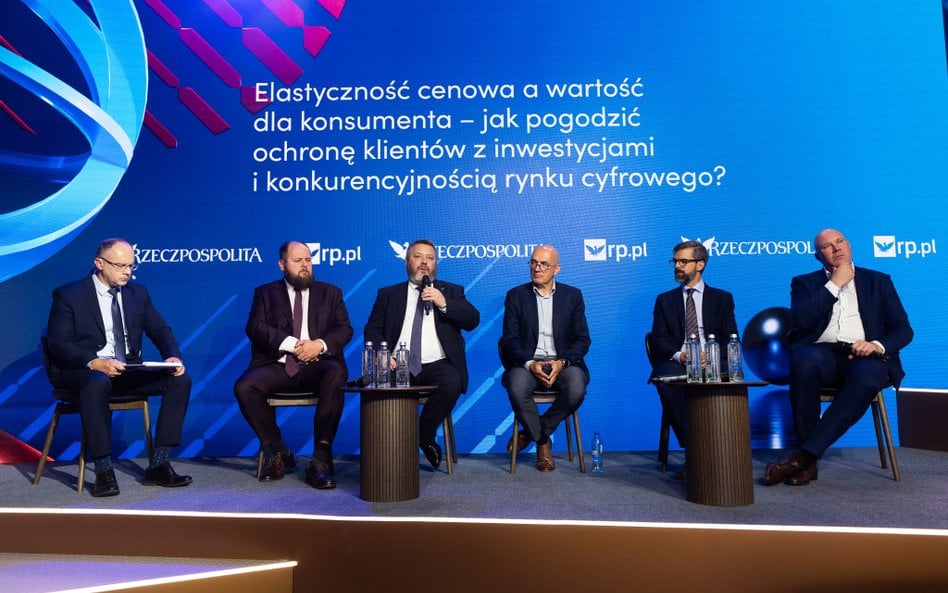
A central issue is long-term, open-ended contracts, which operators are unable to adapt to changing circumstances. The industry is proposing amendments to Article 308 of the Electronic Communications Act; regulators have declared their readiness for dialogue, but the Office of Competition and Consumer Protection (UOKiK) warns against weakening consumer safeguards.
Costs are rising, but contracts remain unchanged
Poland’s telecoms market is one of the most competitive in Europe, yet it faces enormous investment requirements. As noted by Krzysztof Pstrong, a board member and general director of the Polish Chamber of Electronic Communications (PIKE), there are around 2,600 registered telecoms operators in the country, of which only 16 are large entities. The remainder are micro, small, and medium-sized enterprises operating at a local and regional level.
Meanwhile, service prices remain relatively low. According to data cited by the PIKE representative, Poland's average revenue per user (ARPU) is among the lowest in Europe. Pstrong highlighted that across the European Union, ARPU is typically 49 per cent higher for internet access, 37 per cent higher for pay-TV, and 86 per cent higher for mobile services. However, whilst this situation benefits customers, it poses a challenge for operators, who must simultaneously finance network modernisation, new technologies, and digital security.
Pstrong noted that between 2019 and 2024, real revenues in the telecoms sector fell by 22 per cent, whilst real investment dropped by 15 per cent. Over the next five years, however, the industry will need to allocate around PLN 50 billion to capital expenditure.
Against this backdrop, the PIKE representative argued that one of the most pressing problems is a lack of flexibility to respond to technological shifts and rising costs. This is most clearly illustrated by open-ended contracts. ‘Twenty-two per cent of all telecoms contracts in Poland are open-ended, with an average duration of almost five years (4.7),’ Pstrong said. In his view, these agreements often leave operators unable to adapt terms and conditions to developments that occur years after the initial signing. The issue stems from rising licensing costs, fees payable to collective management organisations, and the need for infrastructure modernisation. Although operators are transitioning from HFC technology to FTTH networks, Pstrong noted that they are not always permitted to amend their service terms accordingly.
The industry is therefore seeking to clarify Article 308 of the Electronic Communications Act. The aim is to establish a clear list of cost-related and technical circumstances that would explicitly define an operator’s right to unilaterally amend contract terms. At the same time, PIKE emphasises that greater flexibility for businesses must be accompanied by robust safeguards for consumers. The industry’s proposal includes, among other provisions, the subscriber’s right to terminate their contract within 30 days without incurring any penalty fees.
Pstrong placed particular emphasis on the issue of legacy contracts. He explained that a customer might, for example, have signed a two-year fixed-term contract in 2014, which subsequently rolled over into an open-ended agreement. If the original contract lacked an appropriate mechanism for future modifications, the operator now has very limited scope to adapt it to current market conditions.
‘We are talking about open-ended contracts that can last for as long as ten years,’ the PIKE representative argued. In his view, this is becoming a major problem for operators burdened with a large volume of such agreements, particularly given the simultaneous pressures of rising costs, investment requirements, and regulatory compliance. The new proposals aim to balance technical and financial realities with consumer protection mechanisms, including a grace period, the principle of proportionality, and the option to terminate the contract.
UKE: a balance must be found
Przemysław Kuna, President of the Office of Electronic Communications (UKE), also acknowledges the problem. He noted that the stability of telecoms prices – for years a hallmark of the Polish market – is beginning to undermine the sector's ability to finance new investments.
‘We need to take action now to address both these investment needs and the necessity for telecoms operators to turn a profit,’ Kuna said. At the same time, he stressed the importance of balancing the interests of operators with those of end-users. While acknowledging that operators must be able to secure a return on their investments to fund network roll-outs, maintain infrastructure, and compete in an increasingly demanding market, he warned against allowing sharp price hikes justified solely by cross-border comparisons.
‘The task facing all of us – the operators, the Ministry of Digital Affairs, UOKiK, and UKE – is to develop such a model,’ the UKE President stated. He pointed out that during the recent spectrum auction, operators paid the state a total of PLN 2.5 billion. In his view, this demonstrates the sheer scale of the capital the sector is pouring into development, underscoring the need to ensure businesses can recoup their investments.
UOKiK: pacta sunt servanda
A more cautious stance was taken by Daniel Mańkowski, Vice-President of the Office of Competition and Consumer Protection (UOKiK). While the regulator does not question the need for sectoral development and investment, it insists that trust must remain the bedrock of the relationship between operator and customer.
In the case of fixed-term contracts, UOKiK’s position is clear.
‘Pacta sunt servanda,’ Mańkowski reminded. When a commercial provider enters into a fixed-term contract with a consumer, both parties agree to the provision of a service under specific terms and for a set fee. The consumer must be able to plan their household budget, just as the provider must be able to assess the commercial risks of running its business.
The situation is different for open-ended contracts. Here, UOKiK considers that current regulations already permit adjustments related to the cost of service provision. The problem, however, lies in how these changes are implemented. Customers must know when, under what circumstances, and on what terms a price increase might occur. They should not be caught off guard by a price hike shortly after signing a contract, nor should they face a scenario where the provider raises prices multiple times while citing the exact same economic factor. ‘We are listening to, discussing, and understanding the industry’s proposals, so I am hopeful we will be able to iron out these issues,’ Mańkowski stated.
At the same time, the UOKiK Vice-President stressed that amending the law should be a last resort. In his view, existing regulations already provide the necessary tools; before lawmakers opt for further legislative changes, the industry and regulators should exhaust the possibilities offered by the current legal framework and mutual dialogue.
The key issue is not the price rise itself, but its predictability
Witold Chomiczewski, a legislation representative for the Chamber of Digital Economy (IGE), sought to strike a balance between commercial flexibility and consumer protection. In his view, price adjustment clauses must be as precise and transparent as possible. He suggested they could be pegged to objective indicators, such as inflation, and include specific safety nets. Crucially, contracts should detail the exact circumstances that justify a price change and afford the customer ample time to terminate their agreement. Such a solution, Chomiczewski argued, would safeguard consumer confidence whilst increasing the predictability of business decisions.
This principle, he argued, should work both ways. If a business can raise prices in response to rising costs or a specific economic indicator, an analogous mechanism should apply when those metrics fall. ‘If we are addressing the issue of price increases, we should also, as a mirror image of this, simply lower the price when these indicators drop,’ the legal counsel said.
It is not just the telecoms sector that has a problem
The debate highlighted that similar tensions are bubbling up in the e-commerce market. Online retail is increasingly reliant on digital services and subscription models, whilst advances in artificial intelligence are enabling ever more sophisticated personalisation of offers and pricing.
Chomiczewski pointed out that in e-commerce, price adjustment clauses operate primarily within the framework of unfair terms legislation. The problem lies in interpreting what exactly constitutes a ‘valid reason’ for a company to unilaterally amend a contract.
Here too, he argued, greater transparency is vital. Consumers deserve to know which circumstances might trigger a price change, and businesses must clearly explain why they have decided to apply an increase in any specific case.
Trust as an element of competition
Daniel Mańkowski pointed out that transparent pricing rules are not merely a matter of consumer protection; they are also a crucial factor in market competition. If one company clearly informs a customer from the outset that prices may rise under certain conditions, whilst a rival offers a seemingly cheaper service but buries the possibility of price hikes deep within its terms and conditions, the consumer is forced to make a decision based on incomplete information.
‘Consumers, voting with their wallets, will naturally gravitate towards the cheaper offer. But will it actually be cheaper in the long run?’ asked the UOKiK Vice-President. This, he noted, is precisely why protecting consumer confidence and ensuring fair competition are inextricably linked.
Debate participants also agreed that the sheer complexity of both regulations and the contracts themselves remains a significant hurdle. Przemysław Kuna noted that telecoms contracts can run to dozens of pages; given the labyrinth of regulations and clauses that businesses must incorporate, consumers can hardly be expected to fully grasp every provision. In his view, the industry should strive for standardisation and greater transparency in its documentation.
Krystian Olchowik, Director of the GovTech Department at the Ministry of Digital Affairs, shared this sentiment. He admitted that even he cannot recall exactly what is buried in his own contract with the telecoms operator. In his opinion, the core information could easily be distilled onto two simple pages: what the consumer is buying, for how much, under what terms, and for how long. The ministry representative concluded that further dialogue between businesses and regulators is essential to develop a solution that respects both sides of the market.
A regulatory brake on investment?
Another widespread concern is the sheer volume of regulation governing the digital economy. Chomiczewski pointed out that businesses must now contend with the GDPR, consumer regulations, anti-greenwashing rules, the AI Act, and general product safety standards. The problem lies not merely in the volume of these regulations, but in their overlap and the subsequent need for constant IT system adjustments.
This regulatory burden is particularly heavy for small and medium-sized enterprises. The IGE representative cited the chamber’s own research, which revealed that implementing the mandatory requirement to display a product's lowest price over the preceding 30 days cost companies an average of PLN 159,000 in legal fees and IT adjustments. Consequently, he argued, the market needs time to assess how new regulations function in practice, rather than facing a relentless cycle of legislative amendments.
Krzysztof Pstrong drew attention to yet another regulatory headache. In his view, the problem does not lie solely with the legislation itself. ‘A more serious issue is a certain type of regulatory practice. If a regulator initiates proceedings or issues a ruling, the entire market begins to monitor the situation and may freeze similar activities until the matter is fully clarified,’ the PIKE representative explained.
As a result, what he described as a ‘chilling effect’ takes hold, leaving operators uncertain about where the boundary of permissible action actually lies. Ultimately, Pstrong argued, the primary goal must be the pursuit of transparent rules that protect consumers whilst affording operators the flexibility to respond to technical and financial shifts. It is precisely on this battleground that the practical future of modification clauses will be decided.